
The Fascinating Journey of Hot-Air Balloons: From Ancient Dreams to Modern Marvels
Have you ever looked up at the sky and marveled at the sight of a colorful hot-air balloon floating peacefully above? These gentle giants of the air have a rich history that spans centuries, capturing the imagination of dreamers, scientists, and adventurers alike. In this comprehensive guide, we’ll take you on a thrilling ride through the evolution of hot-air balloons, from their humble beginnings to their modern-day applications.

Quick Takeaways
- Hot-air balloons have a history dating back to ancient Chinese sky lanterns.
- The Montgolfier brothers conducted the first manned hot-air balloon flight in 1783
- Modern hot-air balloons are used for sport, tourism, scientific research, and even internet connectivity projects
- Hot-air ballooning continues to set world records and inspire new technological advancements
The Birth of a Dream: Early Concepts and Experiments
Long before humans took to the skies, the idea of flight captivated our ancestors. The journey of hot-air balloons begins with ancient Chinese sky lanterns, small paper balloons lifted by the heat of a small flame. These early prototypes laid the groundwork for what was to come.
Fast forward to the Renaissance, and we find the brilliant mind of Leonardo da Vinci sketching his “aerial screw” – a precursor to the modern helicopter. While not directly related to balloons, da Vinci’s work showcased humanity’s growing obsession with conquering the skies.
In 1670, Francesco Lana de Terzi proposed the “Aerial Ship” concept, bringing us one step closer to the hot-air balloon we know today. His designs, though never built, demonstrated a growing understanding of the principles that would eventually make balloon flight possible.
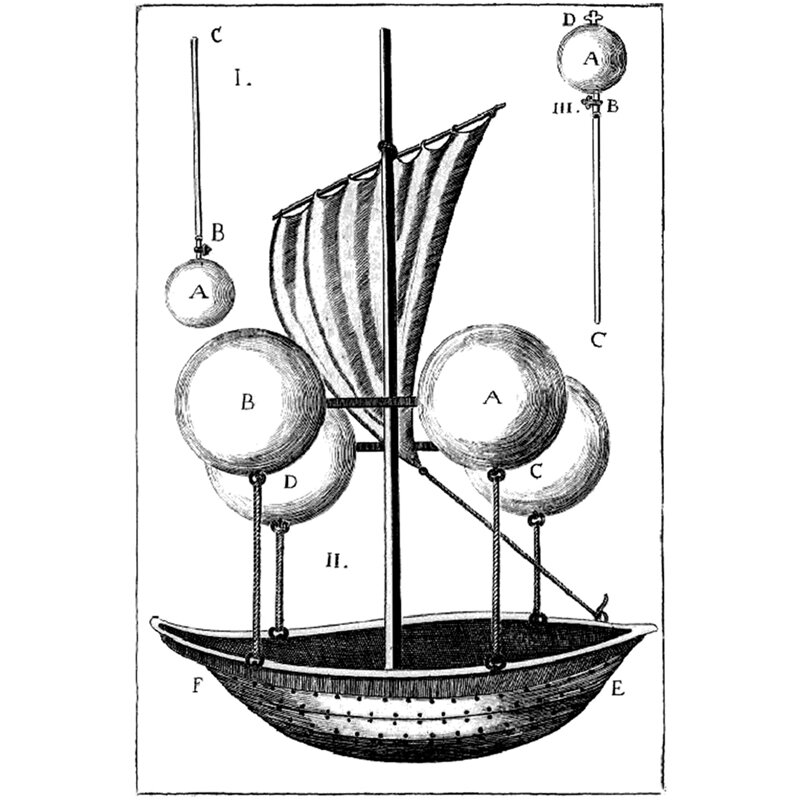
Francesco Lana de Terzi, considered the Father of Aeronautics, designed an aerial ship ( above )in 1670. Inspired by Otto von Guericke’s work on atmospheric pressure, his ship featured four large copper vacuum spheres to provide lift and sails for navigation. Despite his accurate scientific approach, the technology of the time couldn’t support the design, as the copper spheres would collapse under pressure. Lana de Terzi also foresaw the potential military use of such a machine, predicting its destructive power.
The Montgolfier Brothers: Pioneers of Flight
The true birth of hot-air ballooning came with the groundbreaking work of the Montgolfier brothers in the late 18th century. Joseph-Michel and Jacques-Étienne Montgolfier, French paper manufacturers, observed that heated air collected inside a lightweight bag caused it to rise. This simple observation led to a series of experiments that would change the course of history.
Let’s visualize the Montgolfier brothers’ rapid progress:
Montgolfier Brothers’ Milestones
June 4, 1783
First unmanned flight
October 15, 1783
First manned tethered flight
November 21, 1783
First free manned flight
This timeline showcases the rapid progress made by the Montgolfier brothers in just a few short months. Their success sparked a ballooning craze across Europe, with innovators and daredevils eager to take to the skies.
The Golden Age of Ballooning
The 19th century ushered in what many consider the Golden Age of Ballooning. Long-distance flights became more common, and balloons were used for everything from scientific experiments to military operations.
One of the most significant achievements of this era was the first international flight across the English Channel on January 7, 1785, by Jean-Pierre Blanchard and John Jeffries. This daring feat captured the public’s imagination and demonstrated the potential of balloon travel.
During this period, balloons also found their way into popular culture. They became a common sight at fairs and exhibitions, and balloon-themed merchandise flooded the market. The romance and adventure of ballooning inspired artists and writers, leaving an indelible mark on the cultural landscape of the time.
Technological Advancements: Pushing the Boundaries
As with any technology, hot-air balloons underwent significant improvements over time. The late 19th and early 20th centuries saw several key advancements:
- Introduction of the valve line for altitude control
- Development of the rip panel for rapid deflation
- Improvements in envelope materials and construction
These innovations made ballooning safer and more controllable, paving the way for more ambitious flights and applications.

The Modern Era: Ed Yost and Beyond
The modern era of hot-air ballooning began in the 1960s with Ed Yost, often called the “Father of Modern Hot-Air Ballooning.” Yost’s designs incorporated new materials and propane burners, making hot-air balloons more practical and accessible than ever before.
Today, hot-air balloons are used for a variety of purposes:
- Sport and competition
- Tourism and recreation
- Scientific research
- Advertising and promotion
Hot-Air Balloon Usage
This chart illustrates the diverse applications of hot-air balloons in the modern era, with tourism and recreation leading the way.
Hot-Air Balloons in Business and Advertising
To answer a specific question: Yes, hot-air balloons are indeed used in business and advertising today! They offer a unique and eye-catching way to promote brands and products. Some notable examples include:
- The RE/MAX real estate company’s fleet of hot-air balloons
- The Goodyear Blimp (technically a dirigible, but often confused with hot-air balloons)
- Custom-shaped balloons for product launches and events
Businesses find that these balloons provide a memorable and photogenic promotional tool, often generating significant social media buzz. Modern advertising balloons are the result of hot-air balloons.
World Records and Notable Accomplishments
Hot-air ballooning continues to push the boundaries of what’s possible. Here are some impressive world records:
- Highest altitude: 68,986 feet (21,027 meters) by Vijaypat Singhania in 2005
- Longest distance: 3,666.79 km (2,278.23 miles) by Troy Bradley and Leonid Tiukhtyaev in 2015
- Longest duration flight: 160 hours and 38 minutes by Nicolas Tièche and Laurent Sciboz in 2023
These records showcase the ongoing spirit of adventure and innovation in the world of hot-air ballooning.
The Future of Hot-Air Balloons
As we look to the future, hot-air balloons continue to find new and exciting applications:
- High-altitude balloons for scientific research and atmospheric studies
- Project Loon’s internet connectivity balloons (though discontinued, it inspired similar projects)
- Potential use in space exploration, particularly for studying other planets’ atmospheres
The eco-friendly nature of these balloons also positions them well in an increasingly environmentally-conscious world.
FAQ
1. How do hot-air balloons work?
Hot-air balloons operate on the simple principle that hot air rises. By heating the air inside the balloon’s envelope, it becomes less dense than the surrounding air, causing it to lift off the ground.
2. Are these types of balloons safe?
When operated by trained professionals and well-maintained, this type of balloon are generally very safe. However, like any form of aviation, there are inherent risks.
3. How high can a hot-air balloon go?
Most recreational hot-air balloon flights stay below 3,000 feet (914 meters), but specially designed balloons have reached altitudes of over 68,000 feet (20,726 meters).
4. How long can one of these balloons stay in the air?
A typical recreational flight lasts 1-2 hours, but specially equipped balloons have stayed aloft for over 160 hours.
5. Can you steer a hot-air balloon?
While you can’t directly steer a hot-air balloon, skilled pilots can change altitude to catch different wind currents, allowing for some directional control.
From ancient dreams of flight to modern-day marvels of engineering, hot-air balloons have come a long way. They continue to capture our imagination, push the boundaries of what’s possible, and offer new perspectives on our world. Whether you’re an adventure seeker, a history buff, or simply someone who appreciates the beauty of flight, the story of hot-air balloons is sure to inspire and amaze.
So, the next time you see a balloon drifting peacefully overhead, take a moment to appreciate the centuries of innovation, courage, and dreams that have made that flight possible. Who knows? Maybe you’ll be inspired to take to the skies and become part of this continuing story of human achievement.